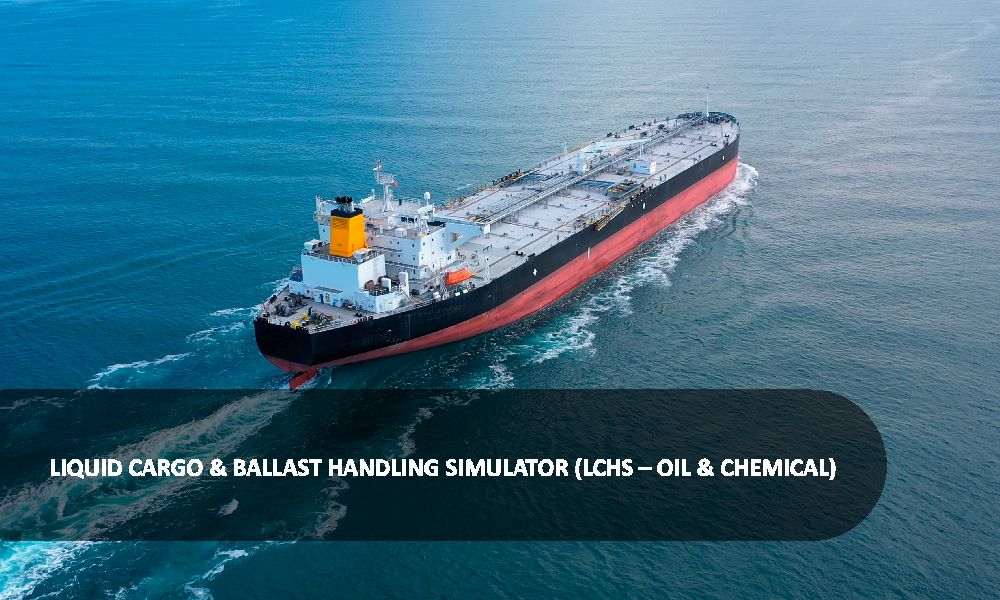
CARGO HANDLING SIMULATOR (LCHS – OIL & CHEMICAL)

30 Students Enrolled
Price
30 Students Enrolled
Modules 8
Skill Level Advanced
Language English ‎(en)‎

Course Overview

AIMS:

The  Cargo Handling Simulator (LCHS – Oil & Chemical) course is designed to provide participants with comprehensive theoretical knowledge and practical skills required for the safe, efficient, and pollution-free handling of liquid cargoes—specifically oil and chemical cargoes—using advanced simulation techniques.

This course is developed in accordance with IMO Model Course 1.37 IMO Model Course 2.06 and is structured to meet internationally accepted standards for maritime industry. It incorporates key principles from relevant IMO guidelines and aligns with industry expectations, including SIRE 2.0 Part 1 – Section 3.3.3.


OBJECTIVES:

    • Understand the properties and hazards of oil and chemical cargoes, including reactivity, toxicity, and flammability.
    • Operate cargo handling systems and instrumentation, including pumps, valves, stripping systems, heating coils, inert gas systems, vapor return systems, and control panels.
    • Perform safe and efficient cargo operations, including pre-loading, loading, topping off, discharging, line flushing, and tank stripping.
    • Apply industry-standard checklists and operational plans, ensuring time management and procedural accuracy.
    • Demonstrate compliance with safety, environmental, and pollution prevention regulations, including MARPOL and ISGOTT guidelines.
    • Manage onboard emergencies, such as cargo spills, equipment failures, vapor leaks, and fire scenarios, using simulator-based drills.
    • Calculate cargo quantities, ullage, trim, stability, draft, and hull stress to ensure safe carriage and structural integrity.
    • Gain practical experience in identifying and resolving operational challenges encountered during cargo and ballast operations.
    • Integrate behavioral competency assessment and bridge teamwork principles, as emphasized in SIRE 2.0, to enhance onboard performance and safety culture.
    • Understand the SIRE 2.0 framework and its direct application to cargo and ballast handling, inspection readiness, and continual improvement onboard tankers.


COURSE CONTENT:

  1. Ship and Tank Familiarization
  2. Special Operations and Procedures
  3. Ballast Operations
  4. Cargo Operations
  5. Operational Problems / Difficulties
  6. LIQUID CARGO HANDLING SIMULATOR   MULTI-MODEL Practical
  7. Familiarization
  8. Special operations and Procedures

Course Content

Instructors

Loading...

Reviews

0

0 Course Rating

0%
0%
0%
0%
0%

Reviews

Enrolment options

AIMS:

The  Cargo Handling Simulator (LCHS – Oil & Chemical) course is designed to provide participants with comprehensive theoretical knowledge and practical skills required for the safe, efficient, and pollution-free handling of liquid cargoes—specifically oil and chemical cargoes—using advanced simulation techniques.

This course is developed in accordance with IMO Model Course 1.37 IMO Model Course 2.06 and is structured to meet internationally accepted standards for maritime industry. It incorporates key principles from relevant IMO guidelines and aligns with industry expectations, including SIRE 2.0 Part 1 – Section 3.3.3.


OBJECTIVES:

    • Understand the properties and hazards of oil and chemical cargoes, including reactivity, toxicity, and flammability.
    • Operate cargo handling systems and instrumentation, including pumps, valves, stripping systems, heating coils, inert gas systems, vapor return systems, and control panels.
    • Perform safe and efficient cargo operations, including pre-loading, loading, topping off, discharging, line flushing, and tank stripping.
    • Apply industry-standard checklists and operational plans, ensuring time management and procedural accuracy.
    • Demonstrate compliance with safety, environmental, and pollution prevention regulations, including MARPOL and ISGOTT guidelines.
    • Manage onboard emergencies, such as cargo spills, equipment failures, vapor leaks, and fire scenarios, using simulator-based drills.
    • Calculate cargo quantities, ullage, trim, stability, draft, and hull stress to ensure safe carriage and structural integrity.
    • Gain practical experience in identifying and resolving operational challenges encountered during cargo and ballast operations.
    • Integrate behavioral competency assessment and bridge teamwork principles, as emphasized in SIRE 2.0, to enhance onboard performance and safety culture.
    • Understand the SIRE 2.0 framework and its direct application to cargo and ballast handling, inspection readiness, and continual improvement onboard tankers.


COURSE CONTENT:

  1. Ship and Tank Familiarization
  2. Special Operations and Procedures
  3. Ballast Operations
  4. Cargo Operations
  5. Operational Problems / Difficulties
  6. LIQUID CARGO HANDLING SIMULATOR   MULTI-MODEL Practical
  7. Familiarization
  8. Special operations and Procedures

Modules: 8
Skill Level: Advanced
Course Duration: 5 Days
Guests cannot access this course. Please log in.

Related Courses

Liquid Cargo Handling Simulator
AIMS MARITIME
AIMS MARITIME

AIMS: This course is developed in accordance with IMO Model Course 1.36 for L...

0
(0)
6 lessons
Liquid Cargo Handling Simulator
AIMS MARITIME
AIMS MARITIME

AIMS: To provide participants with the knowledge and practical skills re...

0
(0)
5 lessons
Liquid Cargo Handling Simulator
AIMS MARITIME
AIMS MARITIME

AIMS: To enhance officers' knowledge and skills in safe chemical cargo h...

0
(0)
5 lessons
Liquid Cargo Handling Simulator
AIMS MARITIME
AIMS MARITIME

AIMS: The LCHS-OIL course aims to provide participants with comprehensive knowl...

0
(0)
5 lessons

Latest Courses

Maritime Safety

AIMS:To equip ship safety officers with the knowledge and skills necessary to pr...

5 lessons
Marine Engineering Skill Development Courses

AIMS:The Tanker Vetting Training Course aims to provide seafarers with a compreh...

5 lessons
Marine Engineering Skill Development Courses

AIMS:To provide participants with the knowledge and practical understanding requ...

5 lessons
Marine Engineering Skill Development Courses

AIMS: To equip engine room watchkeepers and team members with essential leaders...

5 lessons

AIMS:This course equips navigating officers with the essential skills for effect...

5 lessons

AIMS: This course equips navigating officers with the essential skills for effec...

5 lessons

AIMS: This course aims to provide trainees with the essential knowledge, practi...

5 lessons
Maritime Catering

AIMS: To provide seafarers, ship cooks, and catering personnel with the knowle...

5 lessons

AIMS: The aim of this course is to provide shipboard personnel with the knowled...

5 lessons

AIMS: Understand PSC: Grasp the purpose, procedures, and legal fr...

5 lessons
Marine Engineering Skill Development Courses
AIMS MARITIME
AIMS MARITIME

AIMS: To provide participants with a clear, practical, and in-depth unders...

0
(0)
5 lessons
Marine Engineering Skill Development Courses
AIMS MARITIME
AIMS MARITIME

Aims  To give participants a clear understanding of how the Headway OceanGuard ...

0
(0)
5 lessons
loader image