
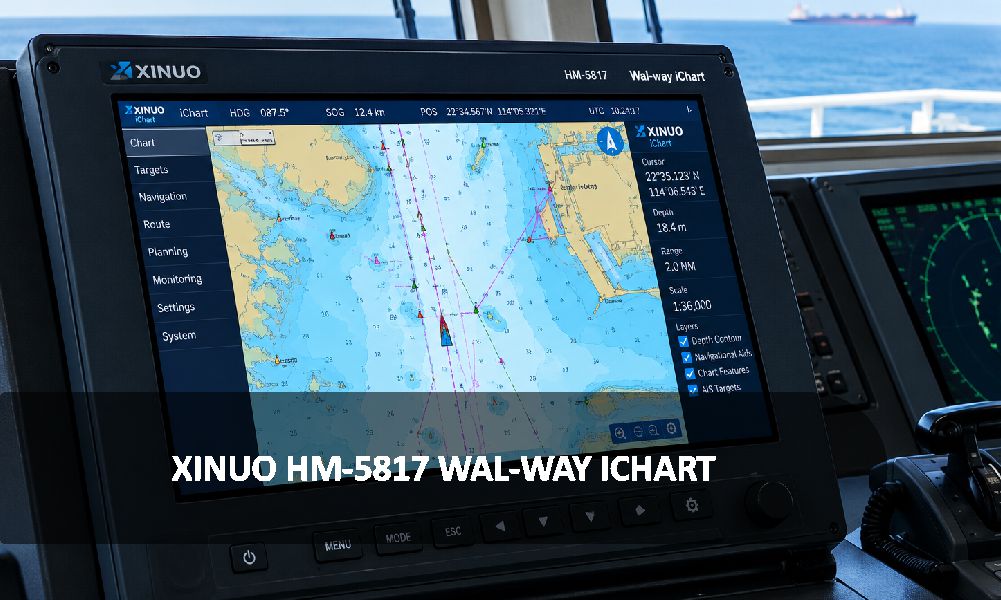
AIMS:
The course aims to give deck officers the knowledge and practical understanding needed to operate the Xinuo HM-5817 Wal-way iChart ECDIS safely and effectively as the primary means of navigation. It builds on a general understanding of ECDIS principles and then applies that understanding to the specific equipment fitted on board. This meets the type-specific familiarisation requirements of STCW Regulation I/14, Section 6 of the ISM Code, and the good-practice guidance in IMO MSC.1/Circ.1503.
OBJECTIVES:
On completion of the course, participants will be able to:
- Explain the purpose of ECDIS, its legal status as a primary means of navigation, and why generic ECDIS training alone does not prepare an officer to use a particular make and model.
- Identify the main hardware components of the HM-5817 installation, including the display, control units, and connected sensors, and describe the function of each.
- Start up, shut down, and restart the system correctly, and recognise normal and abnormal start-up indications.
- Navigate the user interface, menus, and display panels, and configure display settings such as day and night palettes, display categories, safety contours, and safety depths.
- Load, update, and manage electronic charts, including licence and permit handling, and confirm that the chart database is current.
- Verify the input and status of connected sensors such as position, heading, speed, and depth, and recognise when a sensor has failed or is giving unreliable data.
- Create, edit, and save a passage plan, and carry out an automated route check, correctly interpreting and resolving any warnings it produces.
- Monitor a voyage in progress using the route monitoring functions, including cross-track limits, waypoint approach, and look-ahead settings.
- Set, acknowledge, and respond to alarms and indications appropriately, and explain the consequences of incorrect alarm settings.
- Use overlay functions such as radar and AIS where fitted, and understand their limitations.
- Use voyage recording and playback functions, and retrieve logged data when required.
- Describe the back-up arrangements on board and carry out the correct actions in the event of ECDIS failure, including transition to the back-up system or paper charts.
- Recognise the risks of over-reliance on ECDIS and apply sound bridge practices to cross-check the information displayed.
COURSE CONTENT:
Part 1. Product Overview, Installation, Controls and GPS Fundamentals
- Product and Installation
- Controls and Keyboards
- GPS Fundamentals
Part 2. Basic Operation and Settings
- The Main Screen and Chart Control
- Track Recording
- Waypoints, Markers and Beacons
- Planned Routes
- AIS Targets
- Accessory Functions
- Parameter Settings
- Installation and Upgrade
Modules: 11
Skill Level: Advanced
Course Duration: 2 Days
