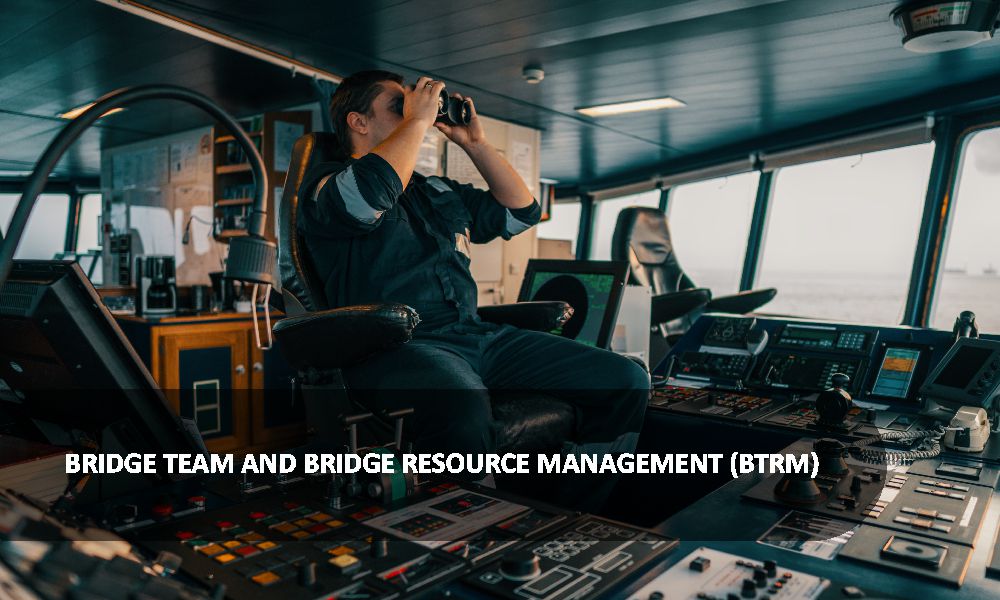
BRIDGE TEAM AND BRIDGE RESOURCE MANAGEMENT

37 Students Enrolled
Price
37 Students Enrolled
Modules 12
Skill Level Advanced
Language English ‎(en)‎

Course Overview

AIMS:

This course equips navigating officers with the essential skills for effective Bridge Team Management and safe decision-making, while enhancing situational awareness, teamwork, and communication on the bridge. It is aligned with IMO Model Courses 1.22 and 1.08, as well as the SIRE 2.0 Part 1 Section 3.3.1 requirements.

This course has been conducted on the Bridge Operation Simulator (ELAB-NAV-E Navigation Simulator) with ECDIS, approved by DNV Class Simulator.


OBJECTIVES:

    • Introduction to BTRM:
        • Understand the foundational concepts of effective bridge team and resource management.
    • Bridge Resource Optimisation:
        • Learn to utilise personnel, equipment, and information efficiently for safe and effective navigation.
    • Situational Awareness:
        • Maintain a high level of situational awareness regarding vessel position, traffic, weather, and navigational hazards.
    • Watchkeeping Practices:
        • Apply proper procedures for maintaining a safe navigational watch in accordance with international regulations.
    • Navigation and Collision Avoidance:
        • Plan, monitor, and execute passage plans to ensure safe navigation and collision avoidance.
    • Emergency Procedures:
        • Respond promptly and effectively to various emergency scenarios, including man-overboard, fire, grounding, or equipment failure.
    • Effective Communication:
        • Foster clear, concise, and assertive communication among bridge team members to enhance coordination and response.
    • Teamwork and Leadership:
        • Promote effective teamwork, leadership, and assertiveness within the bridge team, especially during high-pressure situations.
    • Understanding Human Factors:
        • Address the influence of human factors such as stress, fatigue, workload, and cognitive limitations on bridge performance.
    • Standard Manoeuvres:
        • Understand and apply standard ship-handling manoeuvres in varying environmental and traffic conditions.
    • Problem Solving and Decision Making:
        • Enhance critical thinking skills to assess situations and make timely, well-informed decisions.
    • Resource Management and Team Coordination:
        • Plan and allocate bridge resources effectively, ensuring optimum coordination during routine and emergency operations.
    • Team Experience Review:
        • Evaluate and reflect on team and individual performance to continuously improve future bridge operations and safety outcomes.


COURSE CONTENT:

  1. Introduction to Bridge Team & Bridge Resource Management
  2. Maintain a safe navigational watch
  3. Navigation analysis
  4. Passage plan
  5. Effective Communication Skills
  6. Teamwork and Leadership
  7. Navigation and Collision Avoidance
  8. Emergency Procedures
  9. Human Factors and Performance
  10. The Analysis of The Team's Experience
  11. Behavioural Competency Assessment
  12. SIRE 2.0 familiarisation

Course Content

Instructors

Loading...

Reviews

0

0 Course Rating

0%
0%
0%
0%
0%

Reviews

Enrolment options

AIMS:

This course equips navigating officers with the essential skills for effective Bridge Team Management and safe decision-making, while enhancing situational awareness, teamwork, and communication on the bridge. It is aligned with IMO Model Courses 1.22 and 1.08, as well as the SIRE 2.0 Part 1 Section 3.3.1 requirements.

This course has been conducted on the Bridge Operation Simulator (ELAB-NAV-E Navigation Simulator) with ECDIS, approved by DNV Class Simulator.


OBJECTIVES:

    • Introduction to BTRM:
        • Understand the foundational concepts of effective bridge team and resource management.
    • Bridge Resource Optimisation:
        • Learn to utilise personnel, equipment, and information efficiently for safe and effective navigation.
    • Situational Awareness:
        • Maintain a high level of situational awareness regarding vessel position, traffic, weather, and navigational hazards.
    • Watchkeeping Practices:
        • Apply proper procedures for maintaining a safe navigational watch in accordance with international regulations.
    • Navigation and Collision Avoidance:
        • Plan, monitor, and execute passage plans to ensure safe navigation and collision avoidance.
    • Emergency Procedures:
        • Respond promptly and effectively to various emergency scenarios, including man-overboard, fire, grounding, or equipment failure.
    • Effective Communication:
        • Foster clear, concise, and assertive communication among bridge team members to enhance coordination and response.
    • Teamwork and Leadership:
        • Promote effective teamwork, leadership, and assertiveness within the bridge team, especially during high-pressure situations.
    • Understanding Human Factors:
        • Address the influence of human factors such as stress, fatigue, workload, and cognitive limitations on bridge performance.
    • Standard Manoeuvres:
        • Understand and apply standard ship-handling manoeuvres in varying environmental and traffic conditions.
    • Problem Solving and Decision Making:
        • Enhance critical thinking skills to assess situations and make timely, well-informed decisions.
    • Resource Management and Team Coordination:
        • Plan and allocate bridge resources effectively, ensuring optimum coordination during routine and emergency operations.
    • Team Experience Review:
        • Evaluate and reflect on team and individual performance to continuously improve future bridge operations and safety outcomes.


COURSE CONTENT:

  1. Introduction to Bridge Team & Bridge Resource Management
  2. Maintain a safe navigational watch
  3. Navigation analysis
  4. Passage plan
  5. Effective Communication Skills
  6. Teamwork and Leadership
  7. Navigation and Collision Avoidance
  8. Emergency Procedures
  9. Human Factors and Performance
  10. The Analysis of The Team's Experience
  11. Behavioural Competency Assessment
  12. SIRE 2.0 familiarisation

Modules: 12
Skill Level: Advanced
Course Duration: 5 Days
Guests cannot access this course. Please log in.

Related Courses

Maritime Safety

AIMS:This course develops the knowledge, skills, and competence required to perf...

5 lessons

AIMSThe Risk Assessment and Risk Management (RARM) course is designed to provide...

5 lessons

AIMS:To provide participants with the knowledge and skills necessary to operate,...

5 lessons

AIMS: The course is based on "Code of safe working practices for merchant seafar...

5 lessons

Latest Courses

AIMS:To equip students with a comprehensive understanding of the International S...

5 lessons

AIMS: The course is based on "Code of safe working practices for merchant seafar...

5 lessons

AIMS:To provide participants with the knowledge and skills necessary to operate,...

5 lessons

AIMS:To provide newly joining and existing ship's cooks, galley assistants, and ...

5 lessons

This course equips seafarers with the essential knowle...

0
(0)
5 lessons

AIMSThe Risk Assessment and Risk Management (RARM) course is designed to provide...

5 lessons
Maritime Safety

AIMS:This course develops the knowledge, skills, and competence required to perf...

5 lessons
Marine Engineering Skill Development Courses

AIMS:The Tanker Vetting Training Course aims to provide seafarers with a compreh...

5 lessons
Marine Engineering Skill Development Courses

AIMS:To provide participants with the knowledge and practical understanding requ...

5 lessons
Marine Engineering Skill Development Courses

AIMS: To equip engine room watchkeepers and team members with essential leaders...

5 lessons

AIMS:This course equips navigating officers with the essential skills for effect...

5 lessons

AIMS: This course equips navigating officers with the essential skills for effec...

5 lessons
loader image